
The path of a foreign doctor to working in Slovakia seems confusing: laws in Slovak, university requirements, rumors in chat groups. In reality, it consists of four clear steps, and each of them can be completed. In this article, we have gathered everything in one place: what the law and the decree say, what the university requires, what the exam looks like through the eyes of those who have taken it, and what to do if it doesn't work out the first time.
What Is the Doplňujúca skúška — Official Context and Legal Basis
The supplementary exam (doplňujúca skúška) is a mandatory assessment of the actual knowledge, abilities and skills of applicants who obtained their medical education in third countries (non-EU member states), required for the recognition of their professional qualifications in regulated healthcare professions in the Slovak Republic.
Key Features of the Exam
Purpose: To verify actual knowledge and the continuity of education under a comparable study program completed abroad.
Where it takes place: According to the law, at an accredited secondary school or higher education institution in Slovakia that provides the corresponding curriculum.
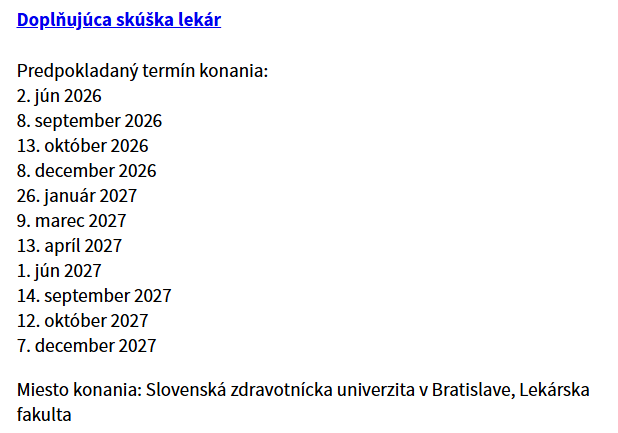
In practice, the exam is held at a single venue — Lekárska fakulta Slovenskej zdravotníckej univerzity in Bratislava (list of dates and venues on the Ministry of Education portal).
It is conducted by an examination board of at least four people, including university staff and representatives of professional chambers (§ 18a ods. 3 422/2015, § 5 30/2018).
Exam language: The exam is conducted strictly in the state (Slovak) language and is public (§ 18a ods. 11 422/2015).
Exam language: The exam is conducted strictly in the state (Slovak) language and is public (§ 18a ods. 11 422/2015).
Exam Structure
Written part: assesses professional knowledge of the relevant healthcare profession and of the generally binding legal regulations governing the provision of healthcare in the Slovak Republic.
Oral part: only candidates who have successfully passed the written part are admitted. Depending on the healthcare profession, for example for dentists, it may include a practical part in simulated conditions.
Result: After successfully passing both parts, the institution issues a record of passing the supplementary exam, which is a mandatory attachment to the application for recognition of professional qualifications. If you fail, the exam can be retaken.
The Application Process
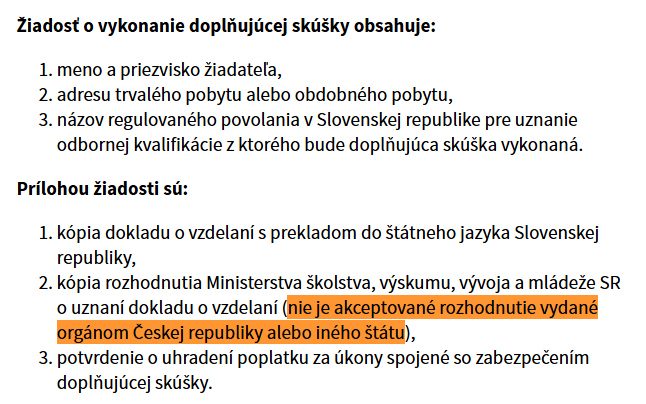
Full recognition of a doctor's diploma from a third country consists of two stages — recognition of the diploma by the ministry and passing the supplementary exam — and the order cannot be changed: only those who already hold a Slovak decision recognizing their diploma are registered for the exam. This is stated explicitly on the portal of the Centre for the Recognition of Documents on Education (Ministry of Education, MŠVVaM SR); it also specifies that a decision issued by a Czech or other foreign authority is not accepted:
«nie je akceptované rozhodnutie vydané orgánom Českej republiky alebo iného štátu»
We did not find such a reservation in the law itself; this is a requirement of the Ministry of Education.
Step 1. Diploma Recognition (uznanie dokladu o vzdelaní)
The application is submitted to the Stredisko na uznávanie dokladov o vzdelaní at the Ministry of Education. A diploma from a third country falls under the general system of recognition (§ 13 ods. 2 422/2015).
The authority checks the completeness of the application within 30 days and issues a decision within two months of receiving the complete application (§ 29 ods. 6 and § 30 ods. 1 422/2015).
There are three possible outcomes: recognition, refusal or a compensation measure.
The application must be accompanied by: a copy of an identity document, copies of diplomas, a transcript of subjects and exams, information on previous education, a detailed syllabus of the subjects studied, proof of payment of the administrative fee and a translation into Slovak (§ 29 ods. 2–4 422/2015).
For documents from third countries, the authority always requires a certified copy or a certified translation (§ 29 ods. 5 písm. b 422/2015).
A new rule has applied since September 1, 2026. Act No. 121/2026 Z. z. (Article V, point 3) added § 62a to the Act on the Recognition of Documents, which states:
«Rozhodnutie vydané podľa § 30 ods. 1, § 32 ods. 1 alebo podľa § 42 ods. 2 je vykonateľné dňom vydania a odvolanie proti nemu nemá odkladný účinok.»
In plain terms: the ministry's decision takes effect on the day it is issued, and there is no need to wait. If someone files an appeal against it, the decision still remains in effect while the appeal is being reviewed. This concerns two decisions under this act: recognition of the diploma (§ 30 ods. 1) and recognition of professional qualifications (§ 32 ods. 1). The third decision mentioned in the provision (§ 42 ods. 2) concerns temporary services and is not relevant to our topic.
The same section adds that the ministry does not separately certify that such decisions have become final:
The same section adds that the ministry does not separately certify that such decisions have become final:
«Právoplatnosť a vykonateľnosť rozhodnutia podľa prvej vety príslušný orgán ďalej neosvedčuje.»
A practical conclusion can be drawn from this (this is our interpretation, not the wording of the law): with a decision recognizing your diploma, you can apply for the exam right away, and with a decision recognizing your qualifications, you can start working right away.
Step 2. Applying for the Exam
The application is submitted not to the ministry but directly to the institution that holds the exam: the portal states explicitly that applications for an announced date are not sent to the ministry. For doctors and dentists, the exam is held by Lekárska fakulta Slovenskej zdravotníckej univerzity in Bratislava (SZU).
The law requires the application to be delivered no later than 30 days before the exam (§ 18a ods. 4 422/2015). The application must state your name, address of permanent or similar residence and the name of the profession (§ 18a ods. 5 422/2015). The university (SZU) requires the following to be attached to the application. This is its own list, and it is slightly stricter than the law:
There are two discrepancies between the law and practice worth noting.
The law requires the application to be delivered no later than 30 days before the exam (§ 18a ods. 4 422/2015). The application must state your name, address of permanent or similar residence and the name of the profession (§ 18a ods. 5 422/2015). The university (SZU) requires the following to be attached to the application. This is its own list, and it is slightly stricter than the law:
- a completed application form, sent together with all attachments at once to Dekanát LF SZU, Limbová 12, 833 03 Bratislava (marked on the envelope “Doplňujúca skúška – lekár / zubný lekár”);
- a certified copy of the diploma with a translation into Slovak;
- a certified copy of the Ministry of Education's decision recognizing the diploma;
- proof of payment of €500 (the payment must include a specific symbol — your date of birth in the format ddmmyy);
- for a repeat attempt — a certified copy of the record of the failed attempt (the written test is valid for a maximum of 1 year).
There are two discrepancies between the law and practice worth noting.
The law simply refers to a “copy” of documents (§ 18a ods. 6 a 422/2015), while SZU requires a “certified copy” (“osvedčená kópia dokladu o vzdelaní s prekladom do štátneho jazyka SR”).
The law allows the application to be completed up until the day of the exam (§ 18a ods. 7 422/2015), while SZU states that an incomplete application will not be accepted for that date: “V prípade, že žiadosť nebude obsahovať všetky potrebné prílohy a nebude uhradená platba je považovaná ako neúplná, uchádzač nebude zaradený na vykonanie doplňujúcej skúšky v danom termíne”. Follow the SZU requirements and, if in doubt, write to the dean's office (dekanat.lf@szu.sk).
The law allows the application to be completed up until the day of the exam (§ 18a ods. 7 422/2015), while SZU states that an incomplete application will not be accepted for that date: “V prípade, že žiadosť nebude obsahovať všetky potrebné prílohy a nebude uhradená platba je považovaná ako neúplná, uchádzač nebude zaradený na vykonanie doplňujúcej skúšky v danom termíne”. Follow the SZU requirements and, if in doubt, write to the dean's office (dekanat.lf@szu.sk).
Application Deadlines for Upcoming Dates
An application received after the deadline is automatically moved to the next date.
Step 3. The Exam
Details are in the next section, “Organization and Format of the Exam at the University”.
Step 4. Recognition of Professional Qualifications
After passing the exam, you need to submit an application for recognition of professional qualifications (uznanie odbornej kvalifikácie) to the same Ministry of Education. A mandatory attachment is a certified copy of the exam record or its “authorized conversion” (zaručená konverzia — conversion of a paper document into a legally valid electronic one; it is done, for example, by notaries). The application is submitted using the form from the portal or in free form (name, address, signature).
How to submit: by post to Ministerstvo školstva, výskumu, vývoja a mládeže SR, Stredisko na uznávanie dokladov o vzdelaní, Černyševského 50, 851 01 Bratislava, or electronically via the “Všeobecná agenda” service on slovensko.sk (for holders of an activated electronic mailbox).
The processing time is one month from receipt of the complete application (§ 32 ods. 1 422/2015).
The recognition decision gives you the right to work as a doctor under the same conditions as those who obtained their qualifications in Slovakia (§ 14 ods. 2 422/2015).
This completes the process of recognizing a foreign doctor's diploma in Slovakia: after the decision, the doctor can work in Slovakia as a doctor without a specialization. Recognition of a foreign doctor's specialization (špecializácia) in Slovakia is a separate process, which we will definitely cover in a separate article.
Organization and Format of the Exam (doplňujúca skúška) at the University (SZU)
The exam for doctors and dentists is held by Lekárska fakulta Slovenskej zdravotníckej univerzity (SZU) in Bratislava. Seven dates are available for 2027, although the law only requires “spravidla dvakrát ročne” (§ 18a ods. 8 422/2015). The Ministry of Education publishes the dates as tentative, and the law requires them to be announced no later than 60 days before the exam (§ 18a ods. 9 422/2015).
What the Law and the Decree Establish
The content, duration and assessment standard of the exam are set by Ministry of Education Decree No. 30/2018 Z. z. “o doplňujúcej skúške”, in force since February 15, 2018. The basis is § 18a of Act No. 422/2015 Z. z..
What SZU Adds
Subjects
For general practitioners:
For dentists:
- internal medicine,
- surgery,
- pediatrics,
- gynecology and obstetrics.
For dentists:
- internal medicine for dentists (Interná medicína pre zubných lekárov),
- surgery for dentists (Chirurgia pre zubných lekárov),
- dentistry (Zubné lekárstvo), which includes:
- restorative dentistry,
- prosthodontics,
- maxillofacial surgery together with oral surgery (dentoalveolar surgery).
Invitation
Information about how the exam will run is sent by e-mail after the application period closes; SZU publishes the detailed schedule after the deadline.
Public Attendance
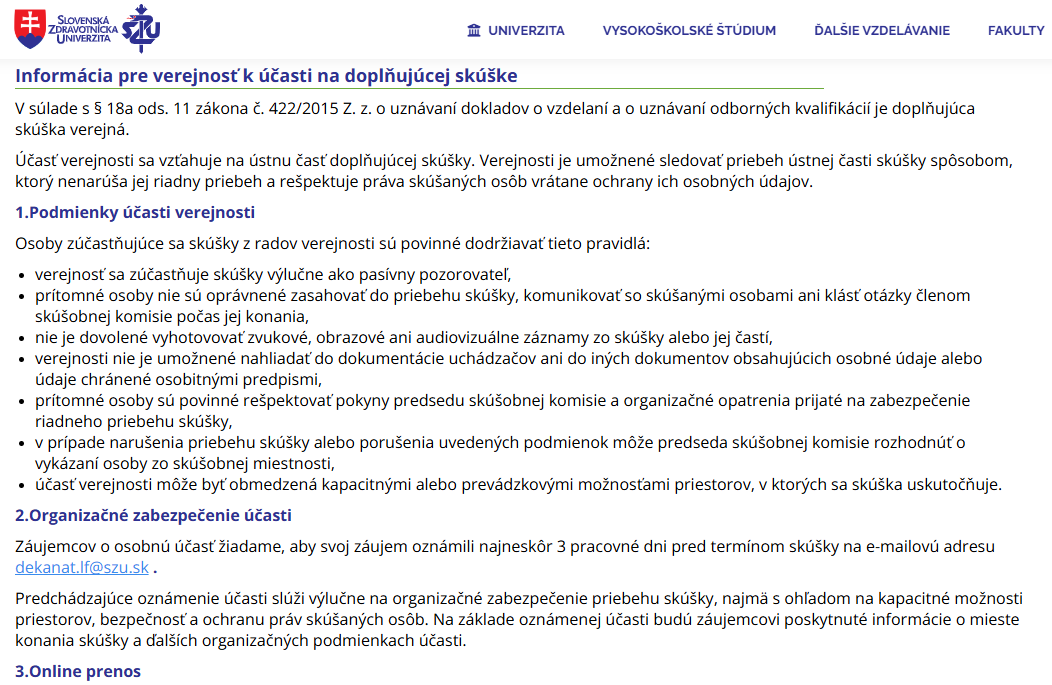
The law makes the exam public (§ 18a ods. 11 422/2015). SZU specifies: members of the public may attend the oral part as passive observers, recording is not allowed, and the visit must be announced at least three working days in advance at dekanat.lf@szu.sk; there is no online broadcast. Details >>>
Absence
An absence can be excused only with a medical certificate submitted within three days after the exam date. In that case, the application can be moved to the next date without paying the €500 again; if you fail to attend without a valid reason, a new application and a new payment will be required.
The decree provides for a more lenient rule: with a proper written excuse, the institution refunds the fee and returns the attachments (§ 6 ods. 1 30/2018). In practice, the SZU rule applies.
The decree provides for a more lenient rule: with a proper written excuse, the institution refunds the fee and returns the attachments (§ 6 ods. 1 30/2018). In practice, the SZU rule applies.
Experience of Participants from Previous Sessions (2024–2025)
To show what the exam looks like from the inside, we regularly talk to exam participants, regardless of whether they passed. Below are five video interviews our team recorded with participants of the 2024–2025 sessions. Four passed on the first try, and one dentist did not pass. The figures in their stories are the participants' personal observations, not official statistics.
Who Is Sharing Their Experience
A general practitioner who graduated about 25 years ago, took the exam at the end of May 2024 and passed on the first try (interview of 20.06.2024).
A dentist who took the exam for the first time in fall 2024 and did not pass (interview of 20.10.2024).
An endocrinologist who prepared fully remotely without living in Slovakia; she took the exam in spring 2024 and passed on the first try (interview of 25.03.2025).
An infectious disease specialist who graduated more than 10 years ago and passed on the first try in spring 2025 (interview of 18.06.2025).
A pediatrician, a 2024 graduate, who passed on the first try in summer 2025 (interview of 28.07.2025).
Watch these and all upcoming interviews with foreign healthcare professionals in our YouTube playlist >>>
What Exam Day Looks Like
The exam takes place on a single day. According to the general practitioner, about 110 people gathered in a large hall in May 2024: roughly 44 doctors and 67 dentists. The test began at around 8:10, the results of the written part were announced at around 12:30, the oral part began at around 13:00, and he learned his final result in the afternoon.
At the fall 2024 session, according to the dentist, there were about 30 dental candidates. The invitation with the time and room arrived about a week after the documents were submitted.
At the fall 2024 session, according to the dentist, there were about 30 dental candidates. The invitation with the time and room arrived about a week after the documents were submitted.
Written Part
Two participants from 2024 mention 100 questions, about 20 of them on legislation. The endocrinologist recalls about 10 questions on law, including several new ones that were not in the preparation materials.
There is enough time: the general practitioner finished the test in 40–50 minutes and estimates that about an hour and a half is allotted for it.
Both doctors from 2024 name legislation as the hardest part of the test: the questions are long, and without good Slovak you cannot understand them.
According to the endocrinologist, the medical block and the law block are graded separately.
Your phone must be switched off, and it is better to take off a smartwatch connected to your phone: you can be removed from the exam for it.
After the test, you can leave and come back for the announcement of the results. The endocrinologist recommends doing exactly that rather than sitting among nervous candidates.
Oral Part
After the test, lists for two rooms are posted. A group of 4–5 people is called into the room; each person draws a question card and prepares while the others answer. The other candidates in the room can hear your answer; this noticeably threw one of the participants off balance.
For general practitioners, the card has four questions, in this order: surgery, internal medicine, pediatrics, obstetrics and gynecology. You cannot change the order, and you may not get to the last question, so participants advise knowing surgery especially well.
You start with a short introduction about yourself: where you are from, where you studied, what you do and how long you have been working. According to participants, there are no questions about why you moved.
You will not be allowed a long monologue: the general practitioner only managed to present the classification before the questions began, 3-4 follow-up questions for each item on the card. If it is clear that the candidate knows the topic, they are quickly stopped and moved on.
Exact drug doses are not required, but you will be asked about drug groups and management.
Surgical techniques are not expected from an internist: patient complaints, examination and next steps matter more.
For dentists, follow-up questions on the specialty part went down to the level of histology and microbiology: they asked not only what and how to do, but also why.
The result is not announced immediately: after answering, you wait outside the door.
Language
All participants name language as one of the decisive factors. You must answer in Slovak; according to the infectious disease specialist, examiners react poorly to switching to Russian or Ukrainian. If you cannot remember a Slovak term, it is better to say it in Latin (examiners suggest this themselves), and international classifications may be named in English.
The endocrinologist also prepared using the Czech WikiSkriptá and warns that Czech terms are not welcome at the exam; they need to be checked against the Slovak ones.
The dentist had questions repeated to him several times, but he believes he failed not because of the language but because his knowledge was not deep enough.
How They Prepared
Preparation times vary greatly: from two months at 3–4 hours a day for the infectious disease specialist (after a Slovak course up to B2 and a two-month medical Slovak course) to eight months at 10 hours a day for the pediatrician, who did not work during that time.
Almost everyone learned Slovak first and only then studied medicine. The endocrinologist spent six months studying with a tutor twice a week and on her own, then prepared 4–5 hours a day from December to May.
A popular approach: cover all 360 topics by roughly the last month and leave the last month for revision using your own notes. The endocrinologist kept a notebook for each subject; the pediatrician set aside a month per subject and a month for revision.
The order differs: the endocrinologist started with surgery as the hardest subject for an internist, while the pediatrician, on the contrary, left it for last so it would be fresh in her memory.
Sources: SZU topics, medical Slovak courses, Slovak textbooks on pediatrics and internal medicine, WikiSkriptá, collections in Telegram groups.
Common Mistakes in the Oral Part (According to Doctors Who Passed the Exam)
Staying silent and waiting for questions: It is better to start talking right away: while you are speaking, what you know is being heard.
Answering without structure: A reliable scheme: definition, etiology, classification, pathogenesis, clinical presentation, diagnosis, treatment, prevention.
Answering “yes” or “no”: Even for a closed question, it is better to give a detailed answer.
Failing to manage nerves: A walk before the exam, a switched-off phone, and a few minutes away from the other candidates all help.
Specifically for Pediatricians
The pediatrician says that graduates in the specialty of “pediatrics” must also pass the skúška spôsobilosti before the supplementary exam — it is a test only, it can be taken in Ukrainian, Russian or Slovak, it includes subjects such as neurology, nuclear medicine and immunology, and the fee, according to her, is €200.
You can read about where this additional exam came from and what the situation was like for foreign pediatricians in Slovakia just a few years ago in a separate article — The First Foreign Pediatrician in Slovakia >>>
You can read about where this additional exam came from and what the situation was like for foreign pediatricians in Slovakia just a few years ago in a separate article — The First Foreign Pediatrician in Slovakia >>>
Materials and Preparation Strategy
The official preparation base consists of four topic lists, a reading list and five laws, all of which SZU publishes on its exam page; the university does not publish a separate bank of test questions.
What SZU Provides
Topic lists: 90 topics in each of the four subjects — gynecology and obstetrics, pediatrics, surgery, internal medicine. These are lists of topics (for example, “Preeklampsia”, “Šok”, “Akútna apendicitída”), not ready-made test questions.
Literature: from 7 titles for gynecology to 23 for pediatrics. The list includes Slovak, Czech and English publications, among them Harrison’s Principles of Internal Medicine (18th edition), Sabiston Textbook of Surgery (18th) and Nelson Textbook of Pediatrics (19th); some sources were published as far back as the 1980s–1990s.
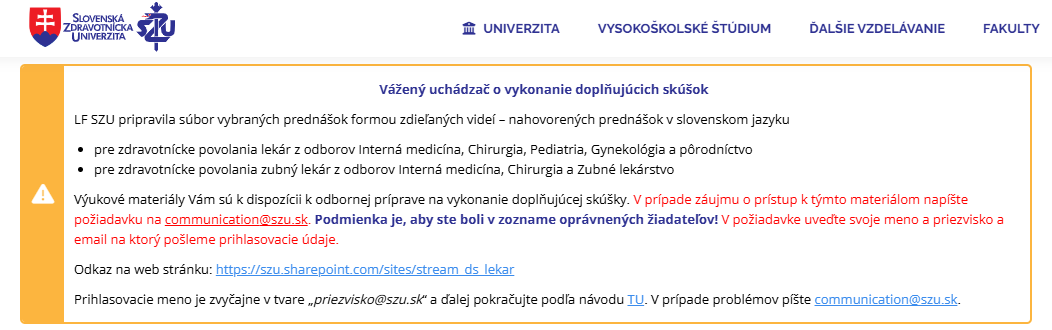
Video lectures: For doctors — in Slovak, on internal medicine, surgery, pediatrics, gynecology and obstetrics; for dentists — on internal medicine, surgery and dentistry. SZU grants access upon request to communication@szu.sk (state your name and e-mail), but only to those already included in the list of admitted applicants.
Important! Information about access to the video lectures is posted on the SZU website, but we have not received real confirmation from a single doctor that these materials exist and that foreign doctors preparing for the exam actually get access to them.
If you have experience preparing with these materials, please write to us at info@medinklud.eu; we have a few questions.
Separate topic lists and literature are published for dentists.
Laws for the law block: The written part includes at least 10 questions on the regulations governing healthcare. SZU lists five laws:
Separate topic lists and literature are published for dentists.
Laws for the law block: The written part includes at least 10 questions on the regulations governing healthcare. SZU lists five laws:
- No. 576/2004 Z. z. on healthcare and services related to the provision of healthcare;
- No. 577/2004 Z. z. on the scope of healthcare covered by public health insurance;
- No. 578/2004 Z. z. on healthcare providers, health professionals and professional organizations;
- No. 580/2004 Z. z. on health insurance;
- No. 362/2011 Z. z. on medicinal products and medical devices.
Timelines
Action Plan After a Failed Attempt
Failing the exam does not close the path, but it makes the legalization process somewhat longer and more expensive. The good news: in Slovakia, the law does not limit the number of attempts, and if you fail only the oral part, you do not have to retake the written test if you return within 12 months (§ 6 ods. 2 and 3 30/2018). The law also explicitly allows a retake (§ 18a ods. 12 422/2015).
Short Checklist
As for the procedure for appealing the exam result, this information deserves a separate article and will require additional time and research. Follow our blog for updates.
The Doplňujúca skúška Is Not a Lottery
There are many rumors around the supplementary exam, and that is understandable: the profession you have devoted years to is at stake. But if you set the rumors aside and look at the documents and at the experience of those who have walked this path, a different picture emerges. The supplementary exam is a serious test, but it is not a lottery.
In a lottery, the rules are unknown and you cannot influence the outcome. Here, it is the other way around. The rules are published and have not changed since 2018. The topics are known in advance: 360 topics across four subjects. The dates are scheduled until the end of 2027. Even failure does not reset the path: the number of attempts is unlimited, and if you fail only the oral part, you do not need to retake the test within a year.
The outcome is decided by what depends on you. Those who passed name the same things: Slovak that you can reason in rather than just recite memorized material; answers with a clear structure, without pausing to wait for questions; topics studied in depth; and the last month devoted to revision. A lucky question card helps, and participants admit this themselves. But luck only adds to preparation; it does not replace it.
You are already a doctor. You have passed exams, made diagnoses, and taken decisions under pressure. The supplementary exam does not test whether you are a doctor. It tests whether you can be a doctor in Slovak. And that is something you can learn.
Stories of those who have already walked this path are in our YouTube playlist. We are now preparing material with participants of the September and October 2026 sessions and will add the link here as soon as it is published. If you would rather not walk this path alone, see how we can help at every stage of relocation and legalization of foreign healthcare professionals in Slovakia.